Women in Science: Inspiring Journeys at Efor
11/02/2026

On February 11th, the world celebrates the International Day of Women and Girls in Science, established by the United Nations General Assembly to promote full and equal access for women and girls to careers in science, technology, engineering, and mathematics.
While progress has been made, gender inequalities still shape research environments, career paths, and access to opportunities. Highlighting diverse voices and experiences remains essential to building a more inclusive and equitable scientific future.
For this occasion, we interviewed three passionate and committed women working at Efor: Ejiro Gbaje-Aleobua, a lead biostatistician; Charlotte Benoit, MD/IVD Evaluation Director; and Aurélie Matera, biotechnology expert. They share their journeys, experiences, the challenges they have faced, and their advice for inspiring the next generation of women scientists.

Ejiro Gbaje-Aleobua (Lead Biostatistician)
Could you briefly introduce yourself and tell us about your background and motivation in the scientific field?
My name is Ejiro Gbaje-Aleobua and I am a biostatistician and math educator from Brooklyn, NY. I earned my Bachelor’s in Biology and Society from Cornell University and my Master’s in Public Heath in Biostatistics from New York University. I have been in the field of statistics for the past 7 years, and I am passionate about making statistics accessible and easily understandable for others. Throughout my career, I have trained students, doctors, and scientists to apply statistics to their lines of study or work in the most appropriate ways. I have also contributed to advancing research in medicine and public health.
Why do you think diversity and inclusion are important in scientific professions ?
It is vitally important that scientific work, as well as work in all other fields, is designed in a way that can cater to people of different genders, races/ethnicities, disabilities, etc. Although there have been many significant scientific advancements throughout history, if the approaches to developing science have been unjust and discriminatory, then the results of research and development may be inherently biased and may exclude vital parts of society. While we can’t undo what was done in the past, we can strive to make more equitable and inclusive decisions moving forward.
What has been your greatest pride or achievement in your scientific journey so far ?
My greatest pride is that I have educated people in different fields and at different professional levels. It is quite gratifying to know that I have helped to train so many professionals about statistics and to get to see the impact that my teaching has had on the work that they do.
What advice would you give to young girls who wish to pursue a career in science ?
Don’t feel discouraged by any challenges, obstacles, or unjust treatment. While some of these thing should not be, others are part of the process, and difficult experiences can help to strengthen you along your journey. If you are passionate about science, pursue it with all of your heart. Also, advocate for just and equitable conditions so that you can help pave the way for other young girls in the future.

Charlotte BENOIT (MD/IVD Evaluation Director)
Can you introduce yourself in a few words and tell us about your background and motivation in the scientific field?
My name is Charlotte BENOIT, and I joined Efor almost eight years ago. I have always been very interested in science, health, and the solutions that can be provided to patients. I like the rigor and innovation that science brings.
I obtained my PhD in neuroendocrinology in 2012. I really appreciate all aspects of my thesis, but it was very fundamental and not patient-oriented enough. That’s why, once I graduated, I immediately turned to the corporate world. I joined a startup that was developing an innovative medical device for diagnosing cancer, where I supervised all preclinical research activities in collaboration with doctors. I then spent two years as an independent scientific consultant before joining Efor to develop the clinical evaluation business. I am now MD/IVD Evaluation Director.
In your opinion, what are the main challenges facing women and girls in the scientific sector today? Have you faced these challenges? If so, how did you overcome them?
There are many challenges facing women and girls in science, but the first thing that comes to mind is stereotypes and preconceived notions such as “science, math, physics, and computer science are for men.” This is less noticeable in the health professions, where there are more and more women doctors, engineers, and researchers. There is a real lack of female scientific role models that young girls can identify with, but this is changing, as illustrated by the excellent initiative to add the names of 72 women who have made their mark on science to the Eiffel Tower.
There are also barriers that women put up for themselves, as they suffer from a lack of self-confidence more often than men: “I won’t be able to do it,” which can be reinforced by the lack of role models of successful female scientists.
Finally, one of the biggest obstacles for me is balancing work and family life. Although men are increasingly involved in their children’s lives, women still bear much of the mental load of family life on a daily basis and wonder whether they will be able to manage both their personal lives and their careers. Here too, stereotypes die hard, and we still hear all too often that “women are not cut out for management positions.” Sometimes, even some companies can be reluctant to hire a young woman without children who may be absent for several months during each of her future pregnancies.
Why do you think diversity and inclusion are important in scientific professions?
Men and women have different but complementary approaches, ways of thinking, and sensibilities. It would be a shame to deprive ourselves of this complementarity.
And speaking of the field of health, which I know well, there are still far too many studies that focus only on men, even though the male and female bodies function very differently, leading to misdiagnoses and inappropriate treatments for some female patients. Fortunately, more and more doctors are working to raise awareness of these differences among both medical community and general public. One example that comes to mind is the cardiologist Claire Mounier-Vehier, I recommend following her on LinkedIn.
What has been your greatest source of pride or your greatest achievement in your scientific career so far?
My greatest source of pride is also my greatest achievement: balancing my life as a mother of two children, for whom I have primary custody, with my career and all the responsibilities and mental load that come with both. I am very proud to have found a balance between the well-being of my children, my fulfillment as both a mother and a woman, and my professional success.
How do you see the role of women in science evolving in the coming years?
I am very optimistic. We are seeing a lot of change, with many women scientists speaking out to young girls. Education has also evolved and places less pressure and fewer stereotypes on young women who want to pursue a career in science.
They will succeed!
What concrete actions could be taken to further promote the presence of women in scientific fields?
In my opinion, action must be taken from childhood and adolescence onwards to inspire vocations and encourage girls, for example through workshops led by women scientists. Then we need to promote access to prestigious universities for young girls and support them by preventing sexism and harassment in educational institutions. Finally, and much is already being done in this area, we need to promote gender equality in terms of salaries and access to management positions.
What advice would you give to young girls who want to pursue careers in science?
First and foremost, believe in yourself. We are just as legitimate as men 😊.
And then, don’t hesitate to get in touch with women who can explain their jobs to you, the difficulties they face and how to overcome them, but also all the successes they have had.

Aurélie MATERA (Matter Expert Level 2)
1. Can you introduce yourself in a few words and tell us about your background and motivation in the scientific field?
I grew up in an industrial region in the Center of France that saw the emergence of major technological innovations. Industry and science have always been a part of my life: Schneider in Le Creusot (the world’s first steam hammer), Aperam in Gueugnon (leader in stainless steel), coal mines in Montceau-les-Mines (largest coal-washing plant in Europe), Michelin in Blanzy (oversized tires). I have always been very curious and eager to understand how things work; a career in engineering has always appealed to me. It was quite natural for me to choose to enter a scientific preparatory class for engineering school after high school. Following the entrance exams, I was admitted to ENSTBB in Bordeaux (engineering school specialized in biotechnology).
2. In your opinion, what are the main challenges facing women and girls in the scientific sector today? Have you faced these challenges? If so, how did you overcome them?
I believe that gender stereotypes and biases are still present and contribute to the perception that science, in a broad sense, is a “male” field.
Furthermore, since fewer women pursue scientific studies, they are underrepresented in these professional environments, where a predominantly male culture may persist and women may struggle to find their place.
In this context, it is important to know how to adapt to the environment and to both explicit and implicit modes of communication.
One must be able to assert their position and point of view, without trying to dominate but also without fading into the background.
3. Why do you think diversity and inclusion are important in scientific professions?
Not only in science, but also in everyday life!
Diversity is a source of creativity and innovation. When teams are made up of people from different backgrounds, cultures, and experiences, they approach problems from a variety of perspectives. This stimulates creativity and enables the development of innovative solutions to complex issues.
Moreover, diverse teams are better able to raise questions relevant to society as a whole, including often underrepresented groups, ensuring more consistent and useful scientific results.
In addition, unconscious biases can influence study design and subsequently the analysis of results / interpretation of data. A diverse team is more likely to identify and mitigate these biases.
A concrete example in the scientific field with significant impacts:
The lack of representation in certain clinical studies, which have historically been conducted on adult Caucasian men, has led to lower efficacy, inappropriate dosages, or accentuated side effects in other population groups (women, ethnic origins…).
4. What has been your greatest source of pride or your greatest achievement in your scientific career so far?
My contribution to the fight against the Covid-19 pandemic by participating in the industrialization and validation of an anti-Covid vaccine process.
5. How do you see the role of women in science evolving in the coming years?
The number of female students in scientific fields is increasing, which will naturally lead to a greater number of professional women in science: more female role models, better representation, greater inclusion, and a rise in the number of women in scientific leadership positions, on expert panels, juries, and among the winners of major awards. There is a shift in social norms and mindset. This creates a virtuous circle that could lead to the “normalization” of woman in science.
6. What concrete actions could be taken to further promote the presence of women in scientific fields?
To promote scientific careers to women, we must first promote science to the public! Obstacles to girls’ scientific studies can come from their immediate environment; when those around them are familiar with and open to science, their support and encouragement will be different!
Changing mindsets requires long-term action, such as:
- Raising awareness about science from an early age (organizing science workshops in schools, meetings with science students in middle and high school level, inviting professionals to speak, etc.)
- Training teachers to combat gender stereotypes
- Highlighting female role models (they do exist! but are often less well-known or less visible than their male counterparts 😉)
Then, once scientific studies are completed, it’s important to ensure that women can find their place and a healthy balance in the workplace. But that is another issue !
7. What advice would you give to young girls who want to pursue careers in science?
Don’t limit yourself!
You have to trust yourself: don’t doubt your abilities, stop self-censoring, and don’t feel illegitimate (“impostor syndrome”).
These stories remind us that, despite the challenges and lingering stereotypes, women continue to play a crucial role in scientific development and innovation. By promoting diversity, removing barriers, and highlighting female role models, we want to help build a more equitable and innovative scientific environment. At Efor, we are proud to contribute to this momentum.
Efor group
Our CSR commitments
Aware of our social and environmental responsibility, we act every day to make a positive impact on society.
Our news
Discover all our technical articles and news
-
 CSR
CSR24/09/2026
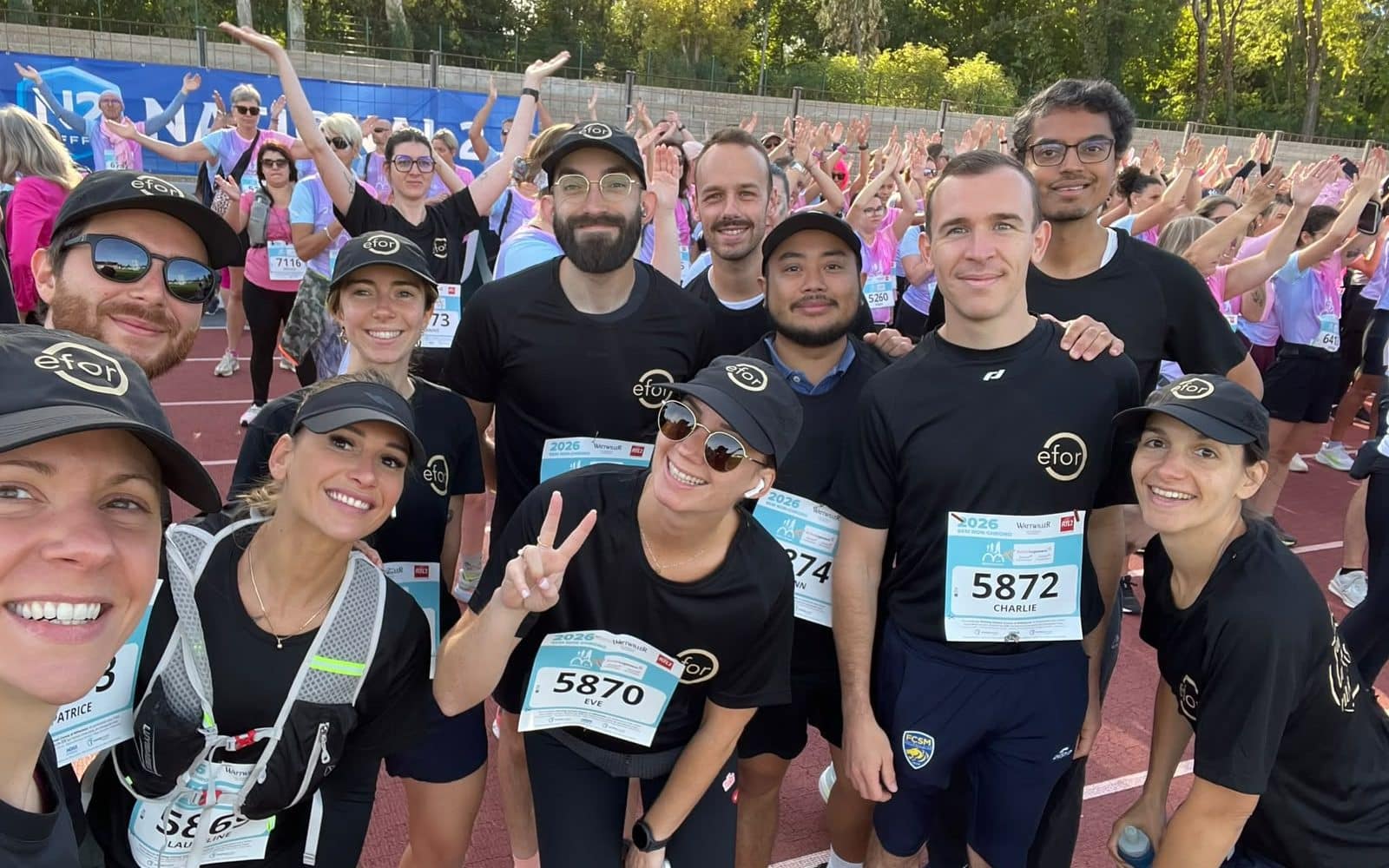
Sport and Solidarity: Team Efor Takes On Toronto and Mulhouse
Our teams laced up their running shoes for two inspiring solidarity races in support of cancer research.
-
 News
News17/09/2026
Efor opens a new office in Amsterdam, the Netherlands
Efor is continuing its northern europe development with the opening of a new office in the Netherlands.
-
 Press releases
16/09/2026
Efor expands into the Netherlands to accelerate growth in Northern Europe
Efor is continuing its international development with the opening of a new office in the Netherlands, at the heart of one of Europ